

“Fusion will be ready when society needs it.”
- Lev Artsimovich, “Father of the Tokamak”
(Note: This is Part 1 of a three-part series. Here’s Part 2 and Part 3.)
Sid Meier’s line of “Civilization” computer games first arrived on the scene thirty-four years ago. The latest version is Civilization VII, which means that Sid & Co. have refreshed the game almost every five years.
Each time, they’ve tinkered with the “tech tree” which allows players to chart their own course through the biggest milestones in human science & engineering (both historical and theoretical). And as the name of the game suggests, these are all civilization-defining milestones. For example: Sailing, Writing, Steam Power… even the Scientific Method itself. Remove any of these foundational branches of technology, and the resulting world becomes a work of speculative fiction.
There is one constant, however, in the final branches of the tech tree in “Civilization” and nearly every other game in the genre: Nuclear fusion. When it comes to energy, all of these games tend to envision fusion as the final, winning move.
This is consistent with the general public’s vision of fusion as an “end of history” breed of technology. After all, fusion is the reaction that powers the stars. One of the grandfathers of fusion science, the Soviet physicist Lev Artsimovich, famously augured that “fusion will be ready when society needs it”. Does anybody doubt that our time of need has now arrived? Humanity desperately needs an abundant source of energy with much lower impact on human health and environmental integrity.
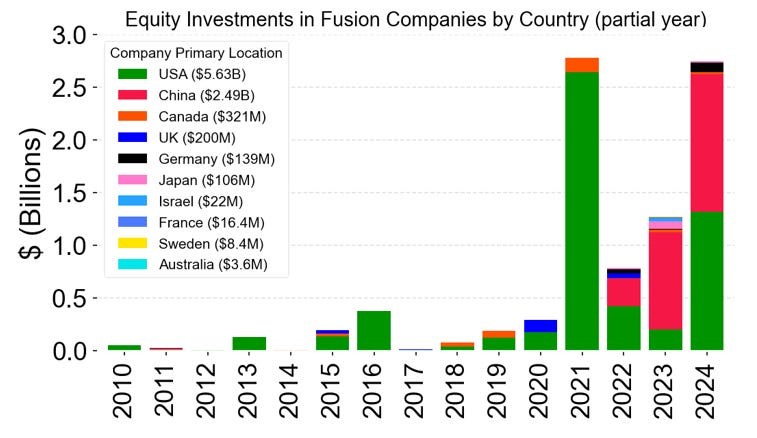
This urgency has led to a small but meaningful outpouring of private capital into fusion technology companies over the past decade — especially during the “climate tech” boom of the early 2020’s. In total, cumulative private fusion investment is approaching $10 billion, mostly in the US and China. There are now several dozen companies which have raised at least $1 million, including about a dozen which have raised over $50 million.
But “Civilization”, the game, is inherently a simplification.
Our real civilization doesn’t actually need fusion, per se. What we need is something fusion-like: a globally-scalable, ultra-low carbon emissions, climate-independent, geology-independent, low-land-use, safe, and affordable source of primary energy. More simply put: We need a replacement for the “primary energy” that’s currently provided by a triumvirate of hydrocarbons — coal, oil, and natural gas — just, without the carbon emissions.
Moreover, our real civilization currently relies on hydrocarbons for two crucial requirements of the global energy system, and commercial fusion would only satisfy one of them.
Hydrocarbons serve as abundant sources of energy — which fusion could theoretically replace — but they also serve as versatile energy carriers. This is because all three of our primary hydrocarbons boast an extraordinary combination of energy density, stability, and ease of transport. Finding a truly reliable substitute for these features of hydrocarbons — just, without the carbon emissions — would be a civilizational milestone practically as world-changing as commercial fusion.
This is why I think it’s important to consider fusion in the context of other fusion-level bets which we, as a civilization, could make for the benefit of the global energy system.
I know of six. And so, I give you six technology bets which are probably just as difficult and uncertain as fusion — which means notoriously, fiendishly so — but could also be just as impactful to the future of energy, and would radically improve our odds of avoiding the worst risks of climate change.
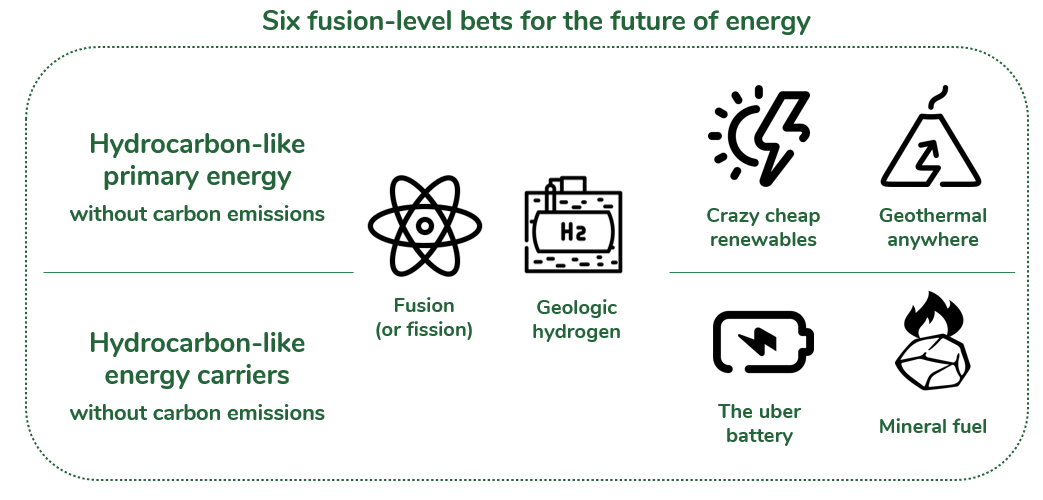
Two of these bets aim to replace the primary energy supplied by hydrocarbons; two aim to supplant hydrocarbons as energy carriers; and two aim to accomplish both, under the right circumstances.
For each technology, I’m going to review:
The Prize: What makes this a fusion-level bet?
The Challenge: What makes this technology so difficult and risky to try to commercialize?
The Path: What would a successful path to commercialization for this technology look like?
This is going to be a three-part series. Naturally, here in Part 1, I’m going to begin with fusion, itself.
Nuclear: to fuse, or to fizz?
The Prize:
I know this may sound strange, but I’m going to begin my assessment of “fusion-level bets” by questioning whether fusion itself should actually qualify.
That’s because The Prize for fusion is, essentially, a superior version of a technology which was initially commercialized in the 1960’s, and already generates nearly 10% of the world’s electricity supply: nuclear fission.
Multiple variations on fission reactor technology have been proven for decades in both commercial and military applications; and fission continues to be a growing source of zero-carbon primary energy. In fact, there are currently around 70 fission reactors under construction around the world (with about half in China).
Also, contrary to public perception, fission energy is already remarkably safe. In fact, by practically any measure, fission has caused fewer deaths than any other major source of energy worldwide, with the exception of solar. (The Chernobyl meltdown was the only event in which a nuclear incident was directly responsible for loss of human life.1) And this safety record is based almost entirely on reactors that were built in the last century — referred to as “Gen II” reactors — which have now been succeeded by “Gen III” reactors with even more robust safety features. (In short: Gen II designs rely on coolant pumps and operator intervention to keep the reactor from overheating, while Gen III designs are cooled completely passively, by gravity or convection.)
Nuclear waste is also, undoubtedly, frightening. Spent fuel represents a big long-term risk to society, because it will remain extremely radioactive for thousands of years. However, spent fuel can already be reprocessed, to some degree, into fuel which can be reused by certain reactors; and emerging reactor designs can make even better use of reprocessed fuel. (See, for example, Moltex.) Moreover, we could theoretically fit all of the spent nuclear fuel ever generated in the entire United States into a single football field, stored in roughly ten foot tall casks. In sum: Spent fuel is a problem, but it’s a very manageable one.
On the other hand, public perception matters, even when the public is so obviously wrong. Here in the US, as in many other advanced economies, the general public has a longstanding fear of nuclear energy, which dates back to the Three Mile Island and Chernobyl accidents. Even nuclear’s biggest supporters among the public often say that they wouldn’t want a nuclear plant in their own backyard.

In one of my first posts here on Steel For Fuel — “When will we get serious about nuclear?” — I described how this unreasonable fear of nuclear energy has led to an overzealous regulatory regime, with the result being untenable compliance costs:
“Where the public has turned against nuclear, governments have turned against nuclear…and it’s nearly impossible to sustain a nuclear program without a supportive policy & regulatory framework — or at least a neutral one. In the US, we have the Nuclear Regulatory Commission, or NRC, whose official job is to oversee nuclear safety & security, but whose putative job appears to be making it impossible to cost-effectively build new nuclear plants. The NRC also seems intent on making it impossible to affordably license new reactor designs.
NRC regulations are notoriously inflexible, and its processes are almost a parody of bureaucratic excess. In the words of one of my nuclear expert friends (who shall remain nameless): “You need NRC approval to move a porta-potty on a nuclear construction site.” Meanwhile NuScale, the only ‘next-generation’ reactor design to be approved by the NRC to date, reportedly spent $500m alone in pursuit of its license. To be clear: this money wasn’t spent on R&D or prototype development; it was spent on consultants and lawyers that NuScale needed in order to progress through the licensing process!
Back in 1999, the staff of the NRC wrote a white paper on the need for more “risk-informed, performance-based” regulation. In other words, more than twenty years ago, the NRC recognized the need for more speed & agility to approve projects whose safety could be validated - even if those projects deviated from established designs or processes. Twenty years later, with no visible progress towards this goal, Congress passed the bipartisan “Nuclear Energy Innovation & Modernization Act” which told the NRC that it was required to develop & implement exactly this kind of more flexible regulation. However, the deadline Congress set is December 2027, and the commission’s first draft of the plan is not inspiring confidence.
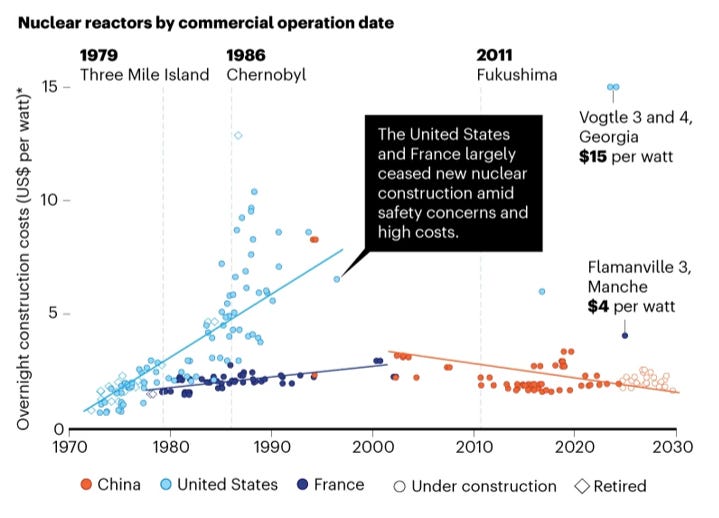
In the meantime, as over two decades have passed, the first new nuclear plant built in the US in ages was conceived, developed, constructed, and has now recently begun splitting atoms, in Georgia. But unfortunately, in part because of the extremely high regulatory burden imposed during construction, the project came in about seven years and $20b over its initial budget – and, along the way, led to the bankruptcy of Westinghouse, a major player in the industry.
So…the US might just take the crown for world’s most onerous nuclear policy & regulatory regime. But at least we’re not Germany, where it’s downright illegal to build new plants, and the government spent the past decade shutting down perfectly good plants that were already operational.
Thankfully, public opinion can change. Since I wrote that article just three years ago, the public has begun turning back in favor of fission in many parts of the world. That includes the USA, where nuclear policy has become one of the vanishingly few areas of bipartisan consensus in Washington. Last year, one of President Biden’s final acts was signing the ADVANCE Act, which was passed by an overwhelming congressional majority, to reform the nuclear regulatory process. In a rare show of policy continuity, the Trump administration has also signaled strong support for nuclear energy.
Meanwhile, in countries where the government has made nuclear energy a major national priority, nuclear plants are now being completed on time, and on budget — just like they were in America back in the 60’s and 70’s. China in particular has demonstrated the power of a concerted national nuclear program, with recent projects consuming less than a fifth of the cost of the only two nuclear units built in America in recent decades.
Lastly, there’s one final reason to stop worrying, and learn to love nuclear fission. Fission reactors can serve double duty as primary energy resources and extremely dense energy carriers. In fact, Uranium-235 is millions of times more energy-dense than gasoline or diesel. Hence, securing a global supply chain to produce and deliver nuclear energy is much, much easier than securing a global supply chain for hydrocarbons.
There’s a reason that the most important ships in the US Navy — submarines and aircraft carriers, whose missions involve long periods out at sea without a chance to refuel — are nuclear powered. The small, modular reactors designed for these ships are unfortunately not a good fit for civilian use — primarily because they run on highly enriched uranium, which represents a proliferation risk for nuclear weapons. However, there are now well over a dozen small, modular reactor technology companies promoting a variety of civilian “SMR” designs, which run on less highly enriched fuel.
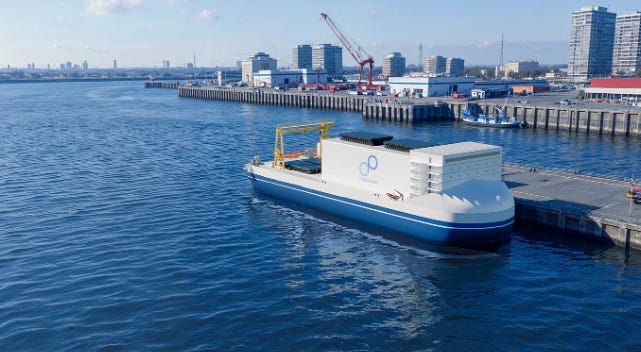
Hence, I’m convinced that nuclear fission is a much better decarbonization pathway for global shipping — as well as intercontinental energy trade — than any of the alternative fuels that are most often proposed. It’s much easier to imagine countries without robust natural energy resources — e.g. Japan & Korea — increasing their reliance on nuclear energy than importing massive amounts of liquefied hydrogen, ammonia, or methanol. The player to watch in this market is Core Power, whose shipyard-based approach to assembling both stationary power and maritime propulsion applications, I find especially promising.
It’s also worth noting that there are currently no realistic fusion reactor concepts with this level of power density. So, while small modular fission reactors are already used for maritime propulsion, fusion it not really on the table.
[An aside: For more on why hydrogen & its derivatives are such weak alternatives for shipping, see my previous posts, “What will we do with all the clean hydrogen?” and “How will we move the big, heavy things?”]
This brings me back to my initial question: Does fusion really represent a fusion-level prize for civilization, relative to fission?
In order to answer this question, I think I need to address The Challenge for nuclear fusion, which is inextricably linked to The Prize.
The Challenge:
Nuclear “fission”, discussed at length above, means splitting atoms. (It’s easiest to use big, heavy atoms like Uranium.) “Fusion” means the opposite: smashing two atoms together until they merge into one. Apparently, atoms resist being smashed together, so it requires a tremendous amount of energy to ignite a fusion reaction. However, a strange thing happens once those atoms finally fuse: the reaction flips, releasing a tremendous amount of energy back into the world.
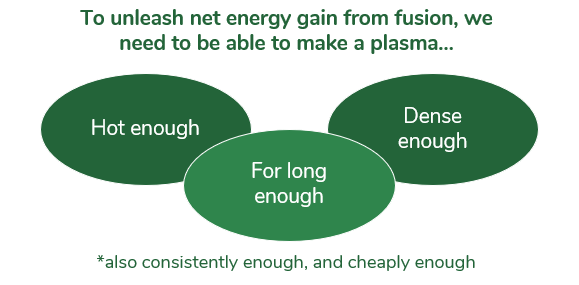
There are three fundamental requirements for igniting a fusion reaction of any kind: 1) The atoms in question need to be close enough to each other, which requires high density. 2) The atoms need to be in an extremely energetic state, which requires high temperature. 3) This state of affairs needs to persist for a long enough time that more fusion energy is produced than the reaction takes to get up & running.
In short, the job of a fusion reactor is to make its fuel “dense enough, and hot enough, for long enough” in order to generate more energy than it takes to initiate the reaction in the first place.
So, why is this so hard?
There are multiple approaches to fusion, which make various trade offs among these three critical variables: heat, density, and time. But in any scenario, “hot enough” generally means at least 100 million degrees, and in some cases over 1 billion degrees.2 Hence, fusion always entails working with ludicrously, incomprehensively hot fuel, in the form of a plasma. (Recall from middle school physics: plasma is a state of matter like solid, liquid, and gas; but plasmas are very rare on planet earth. They only occur naturally during lightning strikes and a few other atmospheric events. The sun is an enormous ball of plasma, which is kept hot enough and dense enough for continuous fusion by its own gravity.)
Unfortunately, plasma is notorious for being a very poorly behaved state of matter. Most importantly for the purpose of commercial fusion, plasmas DO NOT STAY CONTAINED. Attempting to contain a plasma, I’ve been told by fusion experts, is like trying to squeeze grape jelly in the palm of your hand. The tighter you squeeze, the more the jelly tends to slip through your fingers.
This is the core scientific challenge of terrestrial fusion: containing an extraordinarily hot, slippery plasma without relying on the gravity of a star. There is simply no way to do this without expending a ton of energy, but ultimately, you need the resulting fusion reaction to generate more energy than you put in.
The ratio of energy out to energy in is known in the fusion community as “Q”. And so, for decades, the North Star of fusion research has been “Q=1”. To this day, Q=1 has never been achieved, at any cost.*
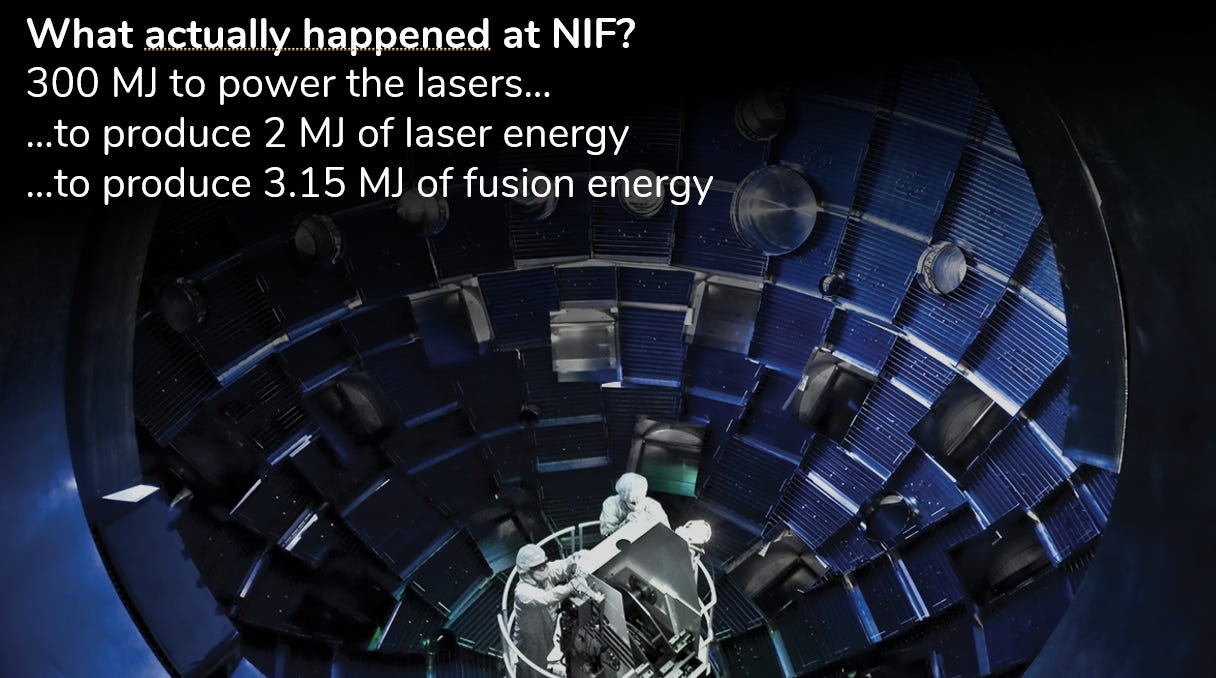
[*You may have seen headlines a few years back that the National Ignition Facility (NIF), a division of Lawrence Livermore National Lab, achieved a “Q=1” kind of milestone. In my view, this was not the right interpretation of what happened at NIF. It’s true that NIF managed to ignite a fusion reaction which generated more energy than it consumed — but only if you draw the system boundary around the reaction itself. In reality, the machine powering the reaction consumed nearly a hundred times as much energy as the reaction produced.]
There are two basic fusion reactions which scientists are attempting to achieve here on earth. Unlike fission, both employ small, lightweight atoms, which are the easiest to fuse. The first is Deuterium-Tritium, often referred to as “D-T”; and the second is Proton-Boron, or “PB11”. Practically, there are two big differences between these options.
First, the D-T reaction is theoretically much easier to initiate, because it only requires reaching a temperature of around 100 million degrees, while PB11 requires a temperature of around 1 billion degrees. Of course, to a layperson, both of these temperatures sound ludicrously, unfathomably high, so it’s easy to gloss over the difference. But a 10X difference in temperature makes a very big difference from the standpoint of engineering and materials science. This is why there are only a few fusion companies pursuing PB11 — for example, the grandfather of private fusion efforts, TAE — while there are a few dozen companies and research labs pursuing D-T.
Second, D-T reactions come with two major complications which introduce substantial engineering challenges.
The first complication involves fuel procurement: The PB11 reaction relies on protons (which are ions of Hydrogen) and Boron, both of which are extremely abundant here on earth. Meanwhile, Deuterium and Tritium are both isotopes of Hydrogen; but while Deuterium is naturally abundant and can be readily extracted from seawater, natural Tritium is exceedingly rare.
The second complication involves radioactivity, because unlike the PB11 reaction, the D-T reaction releases radioactive neutrons. To be clear: D-T fusion produces a much lower level of radioactivity than you’d encounter inside a fission reactor, but neutron bombardment still presents a major problem for reactor design, because neutrons degrade just about everything, in short order. Hence, D-T fusion reactors need some way to protect themselves from neutron radiation, and to extract the energy in those neutrons for conversion into useful heat or power. This set of challenges is broadly described as the “first wall” problem.
I’m happy to report that the fusion community already has an elegant solution to both of these problems — in fact, a single solution which addresses both, simultaneously. The idea is to surround the fusion reaction — typically occurring inside some sort of enclosed reactor vessel — with a protective blanket made of continuously flowing liquid metal. A metal like Bismuth can effectively be employed to absorb and capture the energy from neutron radiation. But crucially, the same liquid metal blanket can also include Lithium-6, a fairly abundant isotope of Lithium. When Lithium-6 is pelted with neutrons, it splits into Helium and — wait for it — Tritium.
Voila! You get a reactor which breeds its own fuel, and produces just a small amount of radioactive waste (roughly akin to the waste produced by medical radiation therapies).
The Prize (part 2)
Hundreds of millions of degrees. Simulating the gravitational force of the sun. Liquid metal blankets breeding Tritium.
Is fusion really worth all of this trouble, given that we already have fission? I believe it could be, for two reasons:
I. Fission fuel is limited in supply, geographically concentrated, and the supply chain faces a number of critical risks; while fusion fuel is widely available around the world. According to the World Nuclear Association, the global identified Uranium resource totals about 8 million tons. That amounts to just about 120 years of supply at our current rate of consumption, which means just 40 years if we were to triple nuclear energy production. Meanwhile, increasing the production of Uranium faces big practical bottlenecks. Siting, permitting, and opening new mines — not to mention maintaining production from existing mines — is a highly specialized and risky endeavor. According to the (excellent) energy market research firm Thunder Said Energy, the global pipeline of Uranium mining projects appears to be insufficient to support demand growth beginning in the early 2030’s.
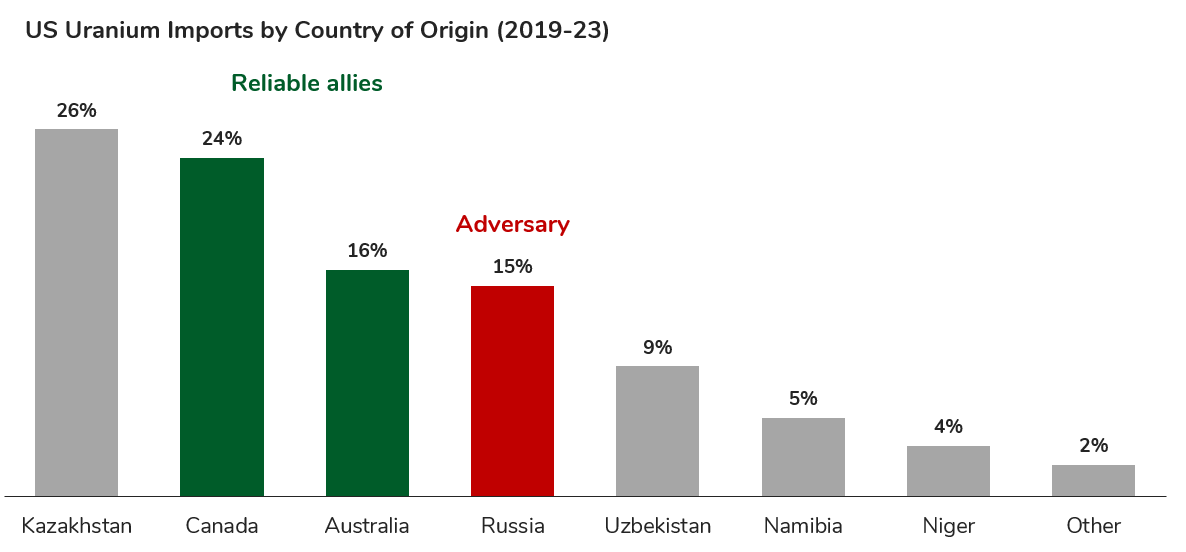
Moreover, neither Uranium resources nor production capabilities are particularly well distributed around the world. Currently, the vast majority of American supply is imported, which has left our nuclear fleet dependent on countries which are not particularly friendly to liberal democracy.
Fusion fuel has some theoretical advantages. The fuel for PB11 fusion is practically infinite, and available everywhere. D-T fuel is admittedly trickier, as it requires breeding Tritium from a relatively uncommon isotope of Lithium. However, even lowball estimates of the global Lithium-6 resource suggest that we can produce enough Tritium fuel to match the energy generation potential of Uranium. Plus, Lithium resource estimates have been growing rapidly, as demand growth from the battery industry has prompted a surge in global exploration.
II. Fusion can achieve roughly the same power-density as fission, but it’s inherently safe and produces minimal harmful waste. These features give fusion a major siting & permitting advantage over essentially every other form of energy production.
Although I’m personally convinced that fission is sufficiently safe for society to bet on, I’ll repeat my prior admonition that public opinion matters, even when the public is obviously wrong. With fusion, there is zero risk of any kind of “runaway” reaction. (The reason fusion is so incredibly difficult in the first place is that fusion reactions are so unstable. The moment we stop putting energy into them, they stop working.)
There’s no long-lived, deadly, radioactive waste to worry about. In fact, there won’t be any emissions from a fusion energy plant at all! This should allow fusion to avoid the vast majority of the regulatory overhead which has caused the cost of fission projects to spiral out of control in the US. Whatever fusion power plants end up looking like, we can be sure that they won’t need massive, protective, concrete containment buildings; they won’t be surrounded by “exclusion zones” extending miles in every direction, and they won’t need dozens of armed guards.
Moreover, fusion plants won’t have smokestacks. They won’t take up lots of land, like solar & wind farms — not to mention oil & gas fields. They won’t block rivers, like hydropower plants. They won’t consume lots of water, like practically every other form of energy production. In short: fusion will be the least environmentally impactful source of energy on the planet. Without fusion, it’s hard to imagine a future world in which humans are able to consume two times, three times, maybe even ten times as much energy as we do today — at least, not without completely overwhelming the biosphere.
So yes, I believe that fusion represents a civilizational prize worth betting on.
Crucially, however, we shouldn’t let the promise of fusion distract us from fission, which is a bet we understand much better, and I believe is worth tripling down on. (At least.)
The Path
Because the core challenge of fusion is containing a slippery plasma, the most definitive feature of any approach to fusion is the strategy it adopts for confinement.
These strategies mostly fall into two camps: magnetic confinement and inertial confinement. There are also a number of hybrid strategies, and a few outliers.
The standard bearer of magnetic confinement is Commonwealth Fusion Systems, which has raised the most money of any private fusion company to date: roughly $3 billion, which is about 30% of all private capital ever invested in the sector. Commonwealth’s fundamental innovation is a novel superconducting magnetic material, which has enabled the company to innovate on a fusion concept which has been around since the time of the “Father of the Tokamak”, Lev Artsimovich. That design is the “tokamak”: a giant, hollow donut made of superconducting magnets.
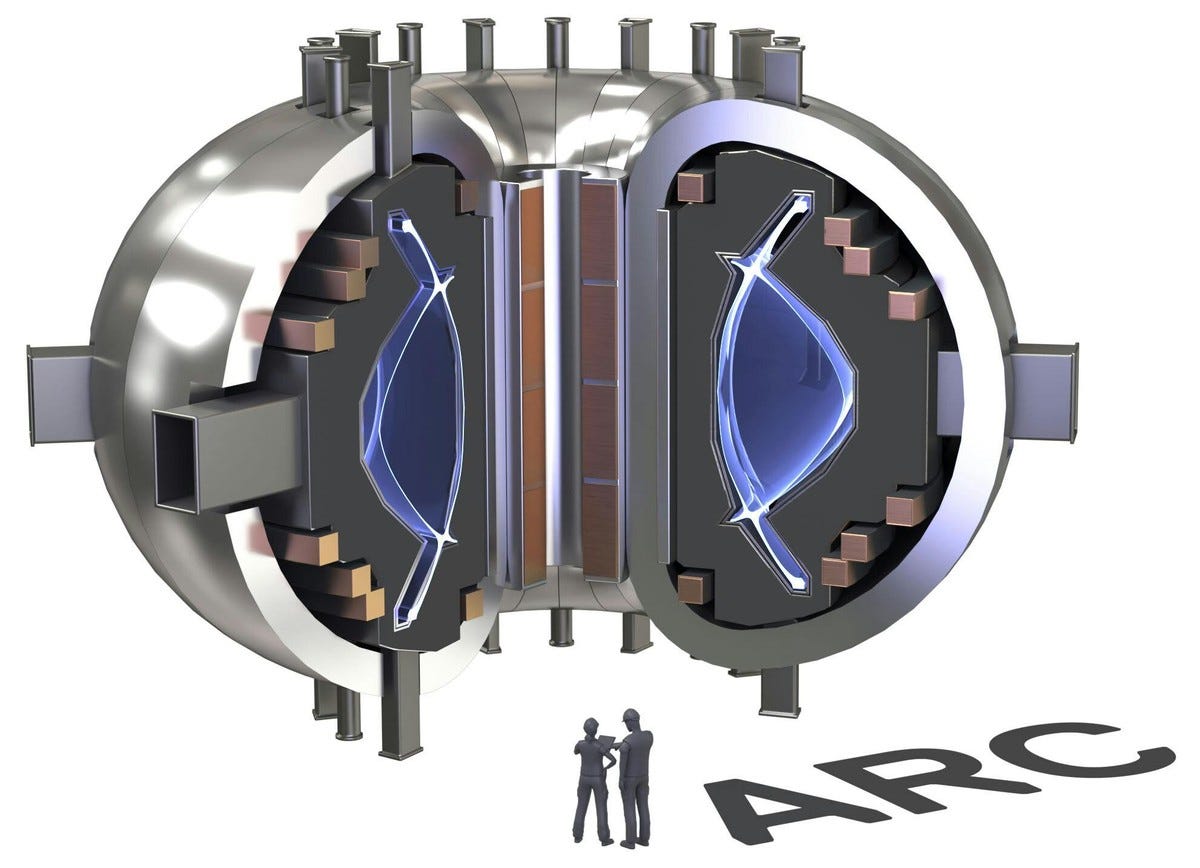
The tokamak is the most well-understood fusion reactor concept, with the longest and most robust research history. It has also received the most attention from world governments — most prominently, as the reactor concept selected for an enormous, multi-decade, multi-national project called ITER. ITER was launched in 2006 with a budget of $5 billion, and a goal of achieving fusion energy production by 2023. The price tag has since risen into the tens of billions, and the timeline for initial fusion has slipped to around 2035. The facility, which remains under construction, is the size of a large football stadium.
Commonwealth’s tokamak design — thanks to the power of its distinctive magnets — is much, much smaller: roughly the size of a “big box store” rather than a stadium. This has enabled the private endeavor to build and iterate much faster than ITER. (ITER has also suffered from all of the delays and cost overruns you can imagine from being a collaborative effort among the governments of the United States, the European Union, China, Russia, India, Japan, and South Korea.) Commonwealth is currently building a demonstration version of its reactor, which is intended to surpass Q=1, in Devens, Massachusetts (where, coincidentally, I grew up playing in Ultimate Frisbee tournaments — so proud).
And so, Commonwealth is fairly widely expected to be the first company to achieve the great, historical accomplishment of net-energy-positive fusion.
However, it’s still not at all clear that this scientific milestone will translate into a commercially viable product. Although the company’s tokamak is much smaller than ITER, it still requires a massive containment structure built out of superconducting magnets, formed into a perfect “toroidal” shape. And because the reactor is relying on D-T fuel, commercial plants will also need to incorporate some form of protective, liquid metal “first wall”, and Tritium breeding system.
And so, it’s entirely possible — I’d even venture to say it’s probable — that humanity will soon “unlock” fusion energy on earth… and still be miles & miles from economically viable fusion.
I don’t mean to pick on CFS. Most other fusion approaches raise similar types of questions. Inertial confinement strategies tend to rely on wildly expensive, high-powered lasers whose efficiency is still much too low for net energy gain. (This is how the National Ignition Facility achieved its questionable scientific milestone.)
At my firm, Energy Impact Partners, we’ve made just one bet on a fusion company: Zap Energy, which is one of the outliers whose strategy doesn’t depend on either magnets or lasers. Zap’s distinctive approach, which the company has dubbed a “Sheared Flow Stabilized Z-pinch”, hearkens back to the only natural source of plasma that most of us experience here on earth: lightning. Zap generates an extremely strong electrical current — kind of like a controlled lightning bolt — to simultaneously heat up and “pinch” the resulting plasma for a fraction of a second.
Here’s an illustration of Zap’s reactor core in action. I’ve stood next to the real thing (well, an experimental version) and it could fit pretty comfortably in my living room.
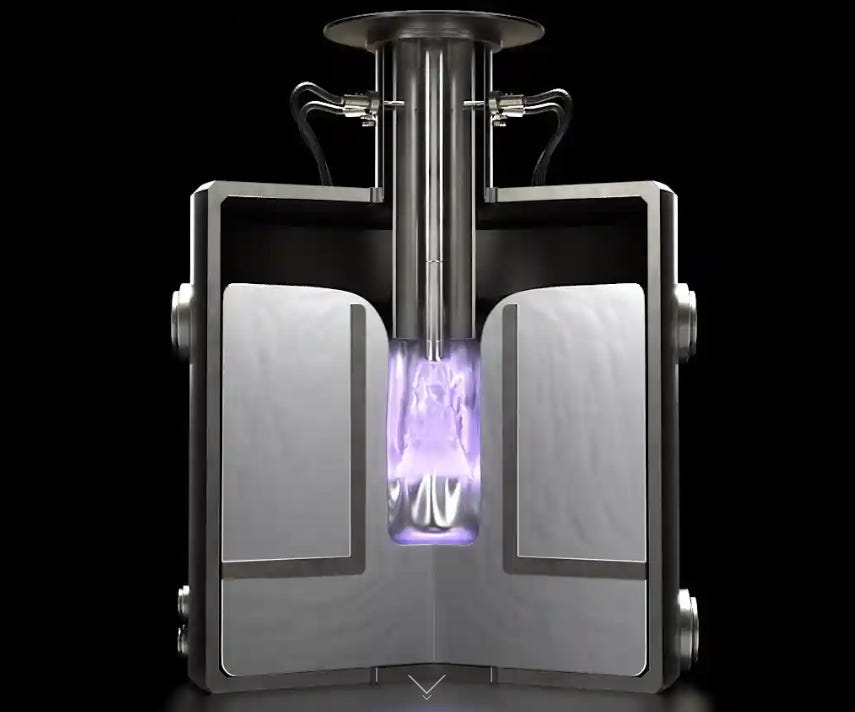
One of the reasons we invested in Zap is that this approach has a promising path to surpassing Q=1. But even more importantly, because the Z-Pinch enables such a compact reactor design, without any outlandish materials or components, Zap has been able to innovate and iterate with greater capital efficiency than its fusion peers. Most importantly, we’re convinced that if the Zap team can achieve net energy gain, they have one of the only plausible pathways to building an affordable fusion power plant.
Taking a step back: I’ve come to believe there’s a good chance that humanity will surpass Q=1 within the next three years. I’d even bet that multiple companies will join the club by 2030. In addition to those I’ve highlighted so far — Zap, Commonwealth, and TAE — there are a handful of other fusion “startups” with credible teams, plans, and financial backers.
Admittedly, this is still fusion we’re talking about, so “a good chance” is tough for me to pinpoint, but I’ll stick with that formulation: I believe there is a good chance we will see a fusion power plant selling electrons to the grid by 2035.
And yet, even in this relatively optimistic scenario, it’s not clear how much fusion will matter for the next couple of decades. In all likelihood, fission will still be significantly cheaper than fusion, at least, in the places where regulators allow it to be. And SMRs may make it easier to put fission to work in a wider range of settings — e.g. for maritime propulsion. Ultimately, I think the upside scenario for fusion requires achieving a fundamentally lower bill of materials than fission, which is a much more difficult threshold to reach than Q=1.
My own take-away is that fusion is a worthwhile bet for the long-term future of civilization. It is, most likely, going to be the “end of history” for energy technology… someday. But for the next few decades — maybe even for the next century — I’m not convinced that fusion represents a sufficiently big leap forward, relative to fission, to pin our hopes on. Ironically, I’ve come to believe that fusion is the least fusion-level technology on my list!
Note: This is Part 1 of a three-part series. Here’s Part 2 and Part 3.
And check out some of my prior posts, for example:
A tale of two energy superpowers

Last year, I concluded a series of Ten Big Questions on the future of energy and climate technology. From the start, I hinted at an even more momentous bonus question.
Is the future of low-carbon industry off grid?

Last December, a group of smart energy thinkers from Scale Microgrids, Paces AI, and Stripe published a thought-provoking white paper which begins with a few observations, and a question:
Nobody died at Three Mile Island, and all of the deaths at Fukushima were caused by the Tsunami, not by the reactor meltdown.
“Degrees” in this post are denoted in Kelvin.
Great post! Just wanted to point out that many of the existing nuclear fusion efforts (like tokamaks) intend to use the thermal energy from fusion to boil water, make steam and turn a turbine. This means a fusion power plant would use just as much water as a fission power plant or a coal power plant. 24/7 power produced with a lack of radioactive waste or emissions would still be awesome, but water consumption wouldn't necessarily be different.